Leave A Message
Dolycon offers an extensive support system to help customers choose the best product. We care about your business and personal needs. Get in touch today.
Quick Answer:
The most frequent VFD installation mistakes that lead to premature equipment failure include inadequate cabinet ventilation, improper star-point grounding, mixing control and power cables, and exposing the drive to harsh environmental conditions. Avoiding these physical and electrical errors extends the lifespan of your variable frequency drive and prevents costly production downtime.
Key Takeaways:
Proper airflow clearance is critical to prevent thermal overload and capacitor degradation.
Motor cables and control cables must be separated to avoid electromagnetic interference (EMI).
High-dust or humid environments require specific IP/NEMA rated enclosures.
Partnering with an experienced VFD manufacturer ensures correct parameter configuration and hardware matching.
1. Inadequate Ventilation and Spacing
A variable frequency drive generates significant heat during the AC-DC-AC power conversion process. Placing drives too close together in a control panel restricts airflow, causing thermal tripping. Always strictly follow the vertical and horizontal clearance guidelines specified in the user manual to allow the cooling fans to operate efficiently.
2. Poor Grounding and Cable Routing
Running incoming power, outgoing motor leads, and low-voltage control wires in the same conduit is a guaranteed way to induce electrical noise and cause erratic drive behavior. Furthermore, failing to ground the VFD and motor to a single central grounding point (star grounding) can lead to circulating bearing currents that eventually destroy the motor's bearings.
3. Ignoring Environmental Hazards
Installing a standard IP20 AC drive in a high-dust, high-moisture, or chemically corrosive industrial setting without a sealed protective panel will quickly short out the internal circuit boards. Assess ambient temperature, humidity, and airborne contaminants before selecting the final installation location.
Installation Practices Comparison
| Installation Factor | Poor Practice (High Risk) | Best Practice (Manufacturer Recommended) |
| Cable Routing | Mixed power and control cables | Separate conduits, crossing at 90° angles |
| Clearance | Packed tightly to save cabinet space | Minimum 50mm side / 100mm vertical spacing |
| Grounding | Daisy-chained ground wires | Star-point direct grounding to the main bus |
| Environment | Open installation in dusty areas | IP54/IP65 enclosures or clean-room placement |
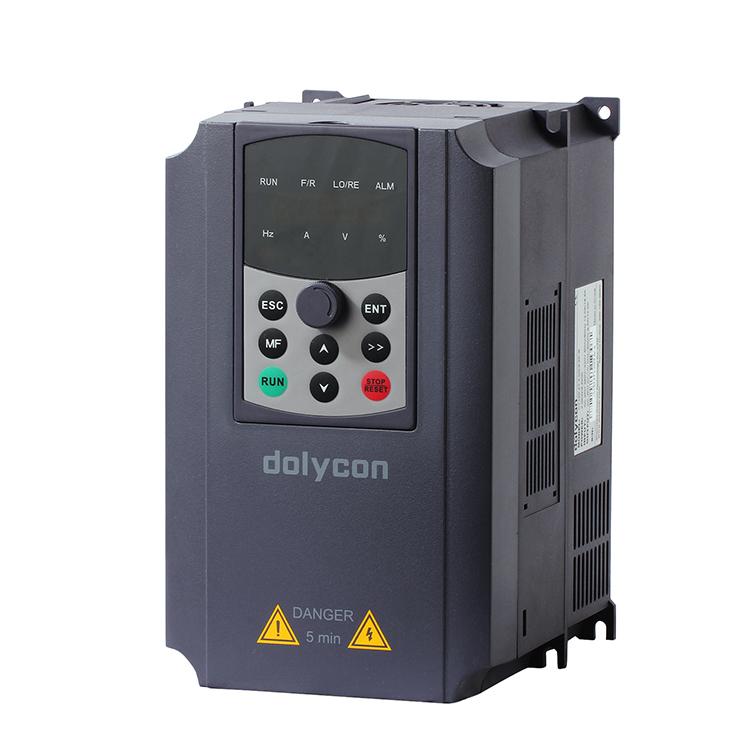
A textile manufacturing client recently experienced recurring overheating faults with their existing drives. Upon inspection, our engineering team found the drives were installed in a non-ventilated cabinet with heavy conductive lint buildup. We replaced the damaged units with the Dolycon CT100 Series high-performance vector VFD, which features an independent air duct design and a wide voltage tolerance (380V±15%). By utilizing our optimized air-duct cooling structure and upgrading the cabinet seals, the client reduced equipment downtime by 98%. You can view our full range of robust industrial automation solutions at
What is the maximum distance a VFD can be from a motor?
Cable lengths exceeding 50 meters (164 feet) can create voltage spikes due to reflected wave phenomenon, which degrades motor insulation. If long distances are unavoidable, install output load reactors or dV/dt filters to protect the motor.
Why does my VFD keep tripping on overvoltage?
Overvoltage faults during deceleration usually mean the motor is acting as a generator, feeding power back to the drive faster than it can dissipate. Extending the deceleration time parameter or installing an external dynamic braking resistor typically resolves this issue.
Does a variable frequency drive need a neutral wire?
No, standard 3-phase VFDs only require three hot lines (L1, L2, L3) and a dedicated ground (PE). Connecting a neutral wire to the drive's input terminals can cause severe internal damage.


 IPv6 network supported


 English
 فارسی
فارسی français
 русский
 español
 português
 العربية
 Türkçe
 ไทย
ไทย Tiếng Việt