Quick Answer
To meet strict space constraints, complex communication protocols, and unique environmental demands, equipment manufacturers are shifting away from generic off-the-shelf drives. Integrating customized VFD solutions for industrial equipment ensures seamless system compatibility, reduces long-term failure rates, and eliminates the cost of paying for redundant features, ultimately maximizing operational efficiency.
Key Takeaways
-
Precise Hardware Matching:Tailored form factors resolve tight electrical cabinet constraints and optimize heat dissipation.
-
Software Optimization:Custom macro programs and pre-set parameters drastically reduce on-site commissioning time.
-
Cost Efficiency:Stripping away unnecessary generic functions lowers per-unit costs at scale.
-
Brand Protection:OEM designs protect intellectual property and secure after-sales maintenance revenue.
The Limitations of Generic Variable Frequency Drives
For years, machine builders relied on standard, multi-purpose inverters. While readily available, these drives are engineered for a "one-size-fits-all" market. They come packed with hundreds of parameters, diverse I/O terminals, and generic housing designs. For specialized machinery—such as heavy-duty industrial centrifuges, commercial HVAC systems, or precision CNC routers—these generic drives often present distinct disadvantages. The physical footprint may be too bulky for compact machine designs, and engineers spend excessive hours programming drives to bypass irrelevant functions.
Engineering for the Application: Hardware and Software Synergy
The modern approach involves partnering with specialized
variable frequency drive customization manufacturers to engineer a drive that acts as an organic extension of the equipment.
On the hardware side, this means custom enclosure dimensions, specialized mounting orientations (e.g., cold-plate cooling or push-through heat sinks), and specific IP ratings to combat dust or moisture. On the software side, firmware can be written to include application-specific logic, effectively replacing small PLCs. This level of integration simplifies the overall system architecture, minimizes wiring faults, and ensures that the end-user experiences a plug-and-play solution.
Enhancing Brand Value Through OEM Partnerships
Beyond technical specifications, adopting OEM VFD solutions for motor control offers a strategic commercial advantage. By integrating proprietary drives branded with your company's logo and customized human-machine interfaces (HMI), equipment builders prevent end-users from bypassing them to purchase replacement parts from third-party distributors. This secures the aftermarket supply chain and reinforces brand authority in the market.
Standard VFD vs. Customized VFD Solutions
|
Comparison Metric
|
Standard Off-the-Shelf VFD
|
Customized VFD Solution
|
|
Form Factor & Footprint
|
Fixed dimensions; often requires oversized electrical cabinets.
|
Tailored dimensions and cooling designs for exact machine fit.
|
|
Commissioning Time
|
High. Requires manual setting of hundreds of parameters.
|
Minimal. Pre-programmed with application-specific firmware.
|
|
Feature Utilization
|
Low. You pay for communication and I/O features you may never use.
|
High. 100% focused on required features, eliminating redundant costs.
|
|
Intellectual Property
|
None. End-users can source replacements anywhere.
|
High. Custom HMI and algorithms protect aftermarket sales.
|
Real Case Study: Upgrading Industrial Centrifugal Equipment
The Challenge
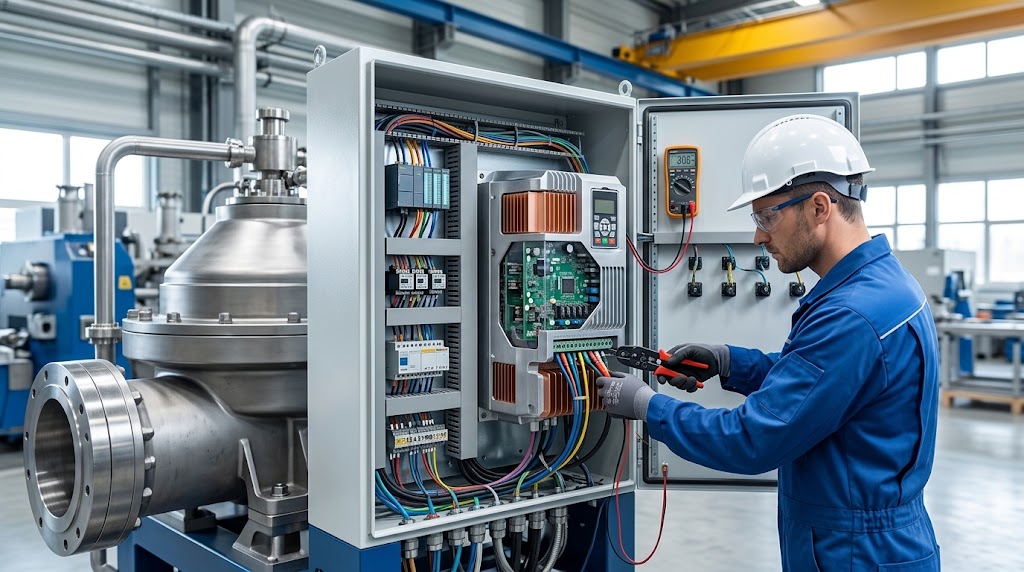
A leading manufacturer of industrial centrifugal separators was experiencing high failure rates due to aggressive chemical environments and intense vibration. Their standard 45kW / 380V drives were continuously tripping due to inadequate low-frequency torque during the heavy load start-up phase.
The Dolycon Solution
Partnering with
Dolycon, the manufacturer transitioned to a custom-engineered AC drive solution. Dolycon’s R&D team developed specialized firmware focused on high starting torque via advanced sensorless vector control. The hardware was re-engineered with conformal-coated PCBs to resist chemical corrosion and a bespoke heat-sink profile that fit precisely into their existing compact control panel.
The Result
The custom integration resulted in a 40% reduction in start-up faults and reduced the overall electrical cabinet assembly time by 25 minutes per unit. This perfectly illustrates the tangible benefits of custom VFDs in manufacturing, moving beyond mere speed control to holistic machine optimization.
FAQ
1. Is there a high minimum order quantity (MOQ) for customized VFDs?
Not necessarily. While purely bespoke hardware redesigns may require volume commitments, software customization, custom branding, and pre-parameterization can often be accommodated with flexible MOQs. Contact our engineering team at Dolycon to discuss your project scale.
2. How long does the VFD customization process typically take?
Depending on the complexity, firmware modifications and parameter presets can be completed in a matter of weeks. Comprehensive hardware redesigns (such as custom form factors or specific environmental sealing) undergo rigorous R&D and testing, typically taking 2 to 4 months from concept to prototype.
3. Will a customized inverter still meet international certification standards?
Yes. Reputable manufacturers ensure that custom solutions still adhere to strict quality control processes. At Dolycon, tailored drives are rigorously tested to comply with CE, RoHS, and other relevant industrial standards, ensuring global market readiness for your equipment.


 IPv6 network supported


 English
 فارسی
فارسی français
 русский
 español
 português
 العربية
 Türkçe
 ไทย
ไทย Tiếng Việt