Quick Answer
Variable Frequency Drives (VFDs) enhance conveyor efficiency by matching motor speed exactly to real-time production demands, rather than running constantly at full speed. Implementing a VFD for industrial conveyor systems drastically lowers energy consumption, utilizes soft-start capabilities to prevent belt snapping, and allows seamless integration with automated plant controls, resulting in higher throughput and fewer maintenance shutdowns.
Key Takeaways
-
Smooth Operations:S-curve acceleration and deceleration profiles prevent product spillage and chain derailments.
-
Equipment Longevity:Eliminating direct-on-line (DOL) voltage spikes helps to significantly
-
reduce conveyor mechanical wear on belts, gears, and bearings.
-
Cost Reduction:Running motors at optimal speeds yields substantial variable frequency drive energy savings, especially during low-load periods.
-
Process Synchronization:Advanced I/O and communication protocols allow conveyors to sync perfectly with robotic arms and upstream/downstream machinery.
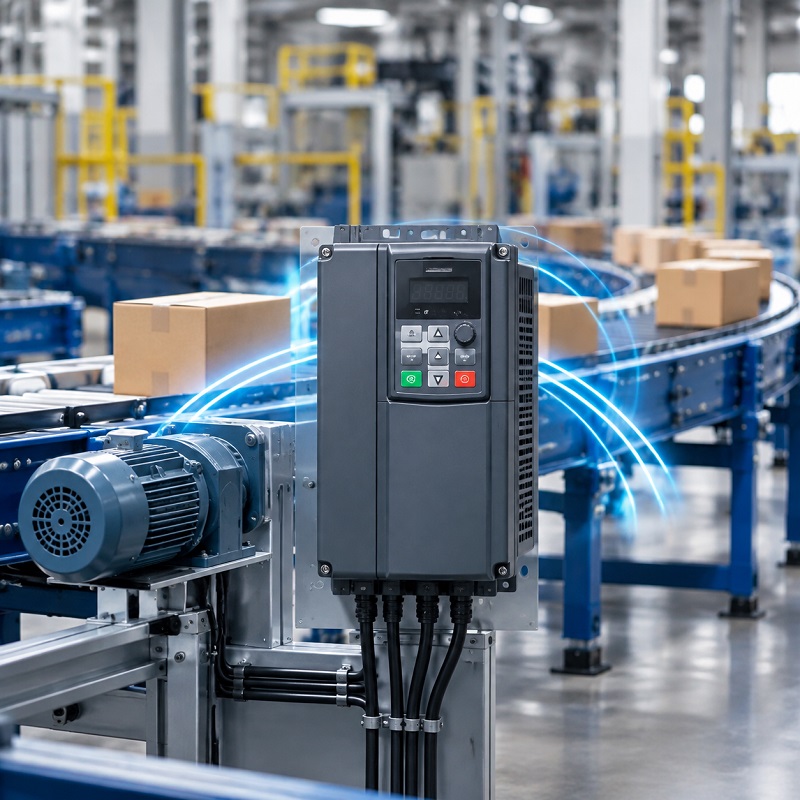
The Challenge of Fixed-Speed Material Handling
In traditional manufacturing setups, conveyor belts often rely on conventional motor starters. When a standard direct-on-line system is powered up, the motor draws an inrush current up to seven times its normal operating rate. This creates a sudden, aggressive jolt. For heavy-duty material handling, this mechanical shock damages the transmission systems over time. Furthermore, fixed-speed systems cannot adapt to fluctuating production lines, meaning the conveyor runs at 100% power even when carrying 20% of its capacity, leading to tremendous energy waste.
Dynamic Speed Control and Plant Automation
Modern facilities require adaptability. By integrating a specialized AC drive for manufacturing automation, plant managers gain precise control over motor torque and speed. If a downstream packaging machine experiences a minor delay, the VFD can automatically slow the feeding conveyor to prevent product pile-ups, rather than halting the system entirely.
Additionally, modern inverters feature built-in PID controllers and support standard industrial networks (like Modbus, Profibus, or Ethernet/IP). This allows the drive to communicate directly with the central PLC, continuously optimizing the conveyor’s speed based on real-time sensor feedback.
Conventional Starters vs. VFD-Controlled Conveyors
|
Performance Metric
|
Direct-On-Line (DOL) Starter
|
VFD Controlled System
|
|
Starting Current
|
600% to 800% of nominal current
|
Maintained below 150% of nominal current
|
|
Mechanical Stress
|
Severe jolts; frequent belt tracking issues
|
Smooth acceleration; extends hardware lifespan
|
|
Process Adjustability
|
Fixed speed (On/Off only)
|
Infinitely variable speed based on demand
|
|
Energy Efficiency
|
Poor during partial loads
|
Excellent (power follows the affinity laws)
|
Real Case Study: Optimizing a Ceramics Plant Conveyor Line
Background
A mid-sized ceramics manufacturing plant operated a 60-meter heavy-duty flatbelt conveyor to transport raw clay materials to the mixing silos. The system utilized a standard 45kW / 380V induction motor. The sudden torque from fixed-speed starts caused frequent material spillage, and the maintenance team had to replace the gearbox bearings twice a year due to mechanical fatigue.
The Implementation
The engineering team decided to retrofit the line with a heavy-duty inverter sourced from
Dolycon. They selected a 55kW AC drive equipped with sensorless vector control. The drive was programmed with a 15-second S-curve acceleration time, allowing the loaded belt to ramp up to production speed gently. Additionally, a feedback loop was established with a weight sensor, automatically slowing the belt when material flow was light.
The Results
Within six months of installation, material spillage during startup was completely eliminated. The smooth torque application extended the gearbox maintenance interval from 6 months to over 18 months. Furthermore, by running at 70% speed during off-peak hours, the plant documented a 28% reduction in the conveyor's overall energy consumption.
FAQ
1. Can I use my existing conveyor motor with a new VFD?
In most cases, yes. Standard three-phase AC induction motors can be paired with an inverter. However, if you plan to run the motor at very low speeds for extended periods, you may need a motor with an independent cooling fan (inverter-duty motor) to prevent overheating.
2. How does a VFD prevent product tipping or spillage on a belt?
VFDs utilize programmable acceleration and deceleration curves (specifically S-curves). Instead of instantly applying full power, the drive gradually increases the motor's speed. This gentle transition prevents the sudden jerking motion that typically knocks products over or spills granular materials.
3. Is it complicated to integrate a VFD into an existing automated PLC network?
Not with modern drives. Professional-grade industrial inverters, such as those manufactured by Dolycon, come with standard communication interfaces like RS485 (Modbus RTU) or optional expansion cards for Profibus-DP and CANopen. This makes integrating them into existing SCADA or PLC architectures straightforward for control engineers.


 IPv6 network supported


 English
 فارسی
فارسی français
 русский
 español
 português
 العربية
 Türkçe
 ไทย
ไทย Tiếng Việt